


Page 21 - economic report 2021
P. 21
crept towards 3.4% in December 2021 due to
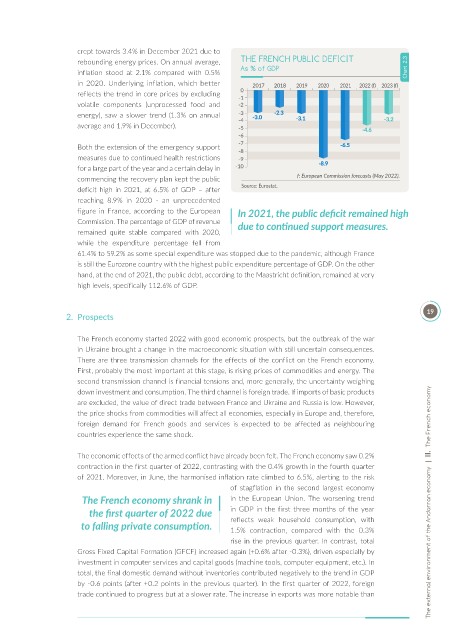
                     rebounding energy prices. On annual average,   THE FRENCH PUBLIC DEFICIT
                     inflation  stood  at  2.1%  compared  with  0.5%   As % of GDP                         Chart  2.3
                     in 2020. Underlying inflation, which better
                     reflects the trend in core prices by excluding
                     volatile  components  (unprocessed  food  and
                     energy),  saw  a  slower  trend  (1.3%  on  annual
                     average and 1.9% in December).


                     Both the extension of the emergency support
                     measures due to continued health restrictions
                     for a large part of the year and a certain delay in
                     commencing the recovery plan kept the public              f: European Commission forecasts (May 2022).
                     deficit high in 2021, at 6.5% of GDP – after   Source: Eurostat.
                     reaching  8.9%  in  2020  -  an  unprecedented
                     figure in France, according to the European   In 2021, the public def cit remained high
                     Commission. The percentage of GDP of revenue   due to cont nued support measures.
                     remained  quite  stable  compared  with  2020,
                     while  the  expenditure  percentage  fell  from
                     61.4% to 59.2% as some special expenditure was stopped due to the pandemic, although France
                     is still the Eurozone country with the highest public expenditure percentage of GDP. On the other
                     hand, at the end of 2021, the public debt, according to the Maastricht definition, remained at very
                     high levels, specifically 112.6% of GDP.


                                                                                                                 19
                  2.  Prospects

                     The French economy started 2022 with good economic prospects, but the outbreak of the war
                     in Ukraine brought a change in the macroeconomic situation with still uncertain consequences.
                     There are three transmission channels for the effects of the conflict on the French economy.
                     First, probably the most important at this stage, is rising prices of commodities and energy. The
                     second transmission channel is financial tensions and, more generally, the uncertainty weighing
                     down investment and consumption. The third channel is foreign trade. If imports of basic products
                     are excluded, the value of direct trade between France and Ukraine and Russia is low. However,
                     the price shocks from commodities will affect all economies, especially in Europe and, therefore,
                     foreign  demand  for  French  goods  and  services  is  expected  to  be  affected  as  neighbouring
                     countries experience the same shock.

                     The economic effects of the armed conflict have already been felt. The French economy saw 0.2%
                     contraction in the first quarter of 2022, contrasting with the 0.4% growth in the fourth quarter
                     of 2021. Moreover, in June, the harmonised inflation rate climbed to 6.5%, alerting to the risk
                                                              of  stagflation  in  the  second  largest  economy
                       The French economy shrank in           in  the  European  Union.  The  worsening  trend    The external environment of the Andorran economy  |  II.  The French economy
                        the f rst quarter of 2022 due         in GDP in the first three months of the year
                      to falling private consumpt on.         reflects  weak  household  consumption,  with
                                                              1.5%  contraction,  compared  with  the  0.3%
                                                              rise in the previous quarter. In contrast, total
                     Gross Fixed Capital Formation (GFCF) increased again (+0.6% after -0.3%), driven especially by
                     investment in computer services and capital goods (machine tools, computer equipment, etc.). In
                     total, the final domestic demand without inventories contributed negatively to the trend in GDP
                     by -0.6 points (after +0.2 points in the previous quarter). In the first quarter of 2022, foreign
                     trade continued to progress but at a slower rate. The increase in exports was more notable than

