


Page 16 - economic report 2021
P. 16
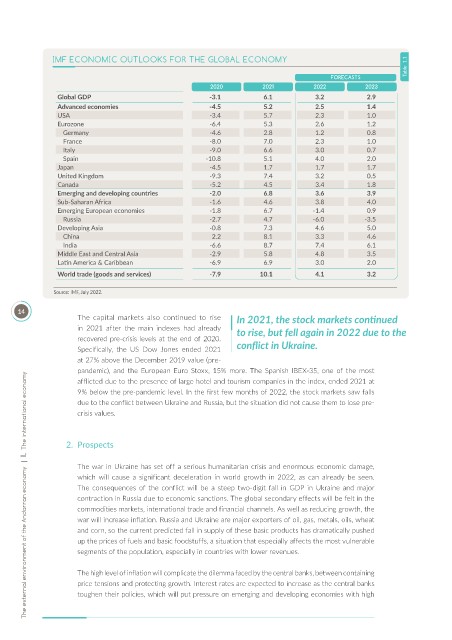
IMF ECONOMIC OUTLOOKS FOR THE GLOBAL ECONOMY
                                                                                                            Table  1.1
                                                                                        FORECASTS
                                                        2020          2021          2022         2023
                Global GDP                              -3.1          6.1           3.2           2.9
                Advanced economies                      -4.5          5.2           2.5           1.4
                USA                                     -3.4          5.7           2.3           1.0
                Eurozone                                -6.4          5.3           2.6           1.2
                  Germany                               -4.6          2.8           1.2           0.8
                  France                                -8.0          7.0           2.3           1.0
                  Italy                                 -9.0          6.6           3.0           0.7
                  Spain                                -10.8          5.1           4.0           2.0
                Japan                                   -4.5          1.7           1.7           1.7
                United Kingdom                          -9.3          7.4           3.2           0.5
                Canada                                  -5.2          4.5           3.4           1.8
                Emerging and developing countries       -2.0          6.8           3.6           3.9
                Sub-Saharan Africa                      -1.6          4.6           3.8           4.0
                Emerging European economies             -1.8          6.7          -1.4           0.9
                  Russia                                -2.7          4.7          -6.0          -3.5
                Developing Asia                         -0.8          7.3           4.6           5.0
                  China                                  2.2          8.1           3.3           4.6
                  India                                 -6.6          8.7           7.4           6.1
                Middle East and Central Asia            -2.9          5.8           4.8           3.5
                Lat n America & Caribbean               -6.9          6.9           3.0           2.0
                World trade (goods and services)        -7.9         10.1           4.1           3.2


               Source: IMF, July 2022.

      14
                     The  capital  markets  also  continued  to  rise   In 2021, the stock markets cont nued
                     in  2021  after  the  main  indexes  had  already   to rise, but fell again in 2022 due to the
                     recovered pre-crisis levels at the end of 2020.
                     Specifically,  the  US  Dow  Jones  ended  2021   conf ict in Ukraine.
                     at 27% above the December 2019 value (pre-
                     pandemic),  and  the  European  Euro  Stoxx,  15%  more.  The  Spanish  IBEX-35,  one  of  the  most
        The external environment of the Andorran economy  |  I.  The international economy
                     afflicted due to the presence of large hotel and tourism companies in the index, ended 2021 at
                     9% below the pre-pandemic level. In the first few months of 2022, the stock markets saw falls
                     due to the conflict between Ukraine and Russia, but the situation did not cause them to lose pre-
                     crisis values.


                  2.  Prospects


                     The war in Ukraine has set off a serious humanitarian crisis and enormous economic damage,
                     which  will  cause  a  significant  deceleration  in  world  growth  in  2022,  as  can  already  be  seen.
                     The  consequences  of  the  conflict  will  be  a  steep  two-digit  fall  in  GDP  in  Ukraine  and  major
                     contraction in Russia due to economic sanctions. The global secondary effects will be felt in the
                     commodities markets, international trade and financial channels. As well as reducing growth, the
                     war will increase inflation. Russia and Ukraine are major exporters of oil, gas, metals, oils, wheat
                     and corn, so the current predicted fall in supply of these basic products has dramatically pushed
                     up the prices of fuels and basic foodstuffs, a situation that especially affects the most vulnerable
                     segments of the population, especially in countries with lower revenues.

                     The high level of inflation will complicate the dilemma faced by the central banks, between containing
                     price tensions and protecting growth. Interest rates are expected to increase as the central banks
                     toughen their policies, which will put pressure on emerging and developing economies with high

