


Page 26 - economic report 2021
P. 26
Accordingly, the fall in full-time equivalent jobs was 7.6% in 2020 and the recovery was 6.6% in
                     2021, so by 2022, only 1.4% of the jobs existing in 2019 are still to be recovered. But, if the actual
                     number of hours worked is considered, the trend is very similar to that of GDP (a drop of 10.6% in
                     2020 and increase of 7% in 2021), and in this case 4.3% of the hours worked before the pandemic
                     are yet to be recovered. Finally, the unemployment rate also fell from 15.5% in 2020 to 14.8%
                     in 2021. In fact, in the fourth quarter of 2021, the unemployment rate had already reached the
                     lowest level (13.3%) since 2008, just before the financial crisis.


                     In 2021, real wages decreased 2.5% due to the effect of rising prices, while productivity saw a
                     downturn of 1.4%. Consequently, real unit labour costs (ULC) shrank, something that had not
                     happened for years, and businesses were able to regain foreign competitiveness.


                     2021  featured  gradual  price  growth,  from   Inflation rebounded due to rising
                     very mild general inflation at the start of the   energy and commodity prices.
                     year (0.5% in January) to a record increase in
                     December  (6.5%).  This  rebound  in  inflation
                     must be blamed on higher commodity prices (food, metals, etc.) and energy prices. The strong
                     recovery in consumption and investment around the world in 2021 meant that the productive
                     capacity  of  the  global  economy  could  not  keep  up,  and  this  therefore  caused  bottlenecks  in
                     commodity supplies and an increase in energy prices. In 2021, this situation had not yet affected
                     other components in the consumer basket, as demonstrated by the fact that underlying inflation
                     in Spain ended the year slightly above 2%.


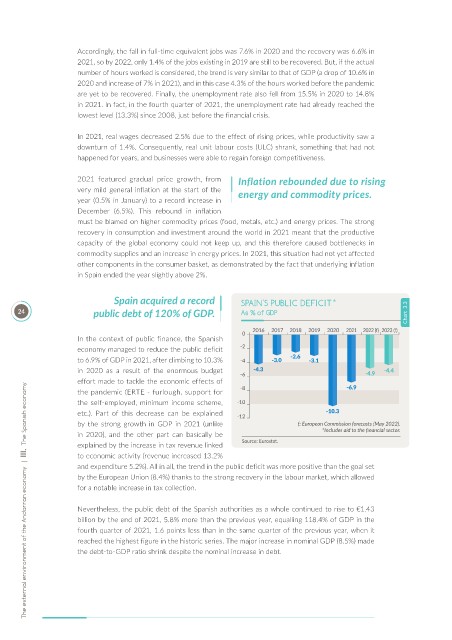
                               Spain acquired a record           SPAIN'S PUBLIC DEFICIT*

      24                  public debt of 120% of GDP.            As % of GDP                                Chart  3.3


                     In the context of public finance, the Spanish
                     economy managed to reduce the public deficit
                     to 6.9% of GDP in 2021, after climbing to 10.3%
                     in  2020  as  a  result  of  the  enormous  budget
                     effort made to tackle the economic effects of
        The external environment of the Andorran economy  |  III.  The Spanish economy
                     the pandemic (ERTE - furlough, support for
                     the self-employed, minimum income scheme,
                     etc.).  Part  of  this  decrease  can  be  explained
                     by  the  strong  growth  in  GDP  in  2021  (unlike       f: European Commission forecasts (May 2022).
                                                                                      *Includes aid to the f nancial sector.
                     in  2020),  and  the  other  part  can  basically  be
                                                                 Source: Eurostat.
                     explained by the increase in tax revenue linked
                     to economic activity (revenue increased 13.2%
                     and expenditure 5.2%). All in all, the trend in the public deficit was more positive than the goal set
                     by the European Union (8.4%) thanks to the strong recovery in the labour market, which allowed
                     for a notable increase in tax collection.


                     Nevertheless, the public debt of the Spanish authorities as a whole continued to rise to €1.43
                     billion by the end of 2021, 5.8% more than the previous year, equalling 118.4% of GDP in the
                     fourth quarter of 2021, 1.6 points less than in the same quarter of the previous year, when it
                     reached the highest figure in the historic series. The major increase in nominal GDP (8.5%) made
                     the debt-to-GDP ratio shrink despite the nominal increase in debt.

