


Page 18 - economic report 2021
P. 18
(22% and 18% of GVA, respectively), a sector   The economic prospects for 2022-2023
                     that  has  been  especially  affected  by  the   are clouded by the war in Ukraine.
                     bottlenecks and rising cost of a large part of
                     their  inputs.  Nevertheless,  in  2022,  public
                     investment as a percentage of GDP is expected to reach the highest level in the last decade
                     thanks to the Next Generation EU programme.


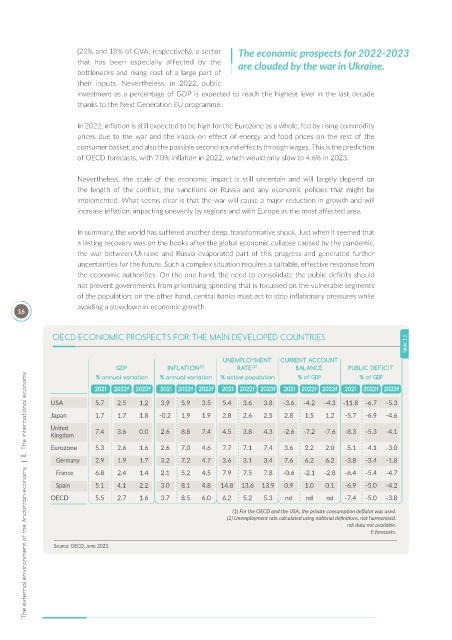
                     In 2022, inflation is still expected to be high for the Eurozone as a whole, fed by rising commodity
                     prices due to the war and the knock-on effect of energy and food prices on the rest of the
                     consumer basket, and also the possible second-round effects through wages. This is the prediction
                     of OECD forecasts, with 7.0% inflation in 2022, which would only slow to 4.6% in 2023.


                     Nevertheless,  the  scale  of  the  economic  impact  is  still  uncertain  and  will  largely  depend  on
                     the  length  of  the  conflict,  the  sanctions  on  Russia  and  any  economic  policies  that  might  be
                     implemented. What seems clear is that the war will cause a major reduction in growth and will
                     increase inflation, impacting unevenly by regions and with Europe as the most affected area.

                     In summary, the world has suffered another deep, transformative shock. Just when it seemed that
                     a lasting recovery was on the books after the global economic collapse caused by the pandemic,
                     the war between Ukraine and Russia evaporated part of this progress and generated further
                     uncertainties for the future. Such a complex situation requires a suitable, effective response from
                     the economic authorities. On the one hand, the need to consolidate the public deficits should
                     not prevent governments from prioritising spending that is focussed on the vulnerable segments
                     of the population; on the other hand, central banks must act to stop inflationary pressures while
                     avoiding a slowdown in economic growth.
      16


               OECD ECONOMIC PROSPECTS FOR THE MAIN DEVELOPED COUNTRIES
                                                                                                            Table 1.2

                                                            UNEMPLOYMENT   CURRENT ACCOUNT
                                GDP          INFLATION (1)      RATE (2)       BALANCE       PUBLIC DEFICIT
        The external environment of the Andorran economy  |  I.  The international economy
                          % annual variation  % annual variation  % active population  % of GDP  % of GDP
                           2021  2022f 2023f   2021 2022f 2023f  2021 2022f 2023f  2021 2022f 2023f  2021  2022f 2023f

              USA         5.7   2.5   1.2  3.9   5.9  3.5   5.4  3.6  3.8   -3.6  -4.2  -4.3  -11.8  -6.7  -5.3
              Japan       1.7   1.7   1.8  -0.2  1.9  1.9   2.8  2.6  2.5   2.8  1.5   1.2  -5.7  -6.9  -4.6
              United      7.4   3.6   0.0  2.6   8.8  7.4   4.5  3.8  4.3   -2.6  -7.2  -7.6  -8.3  -5.3  -4.1
              Kingdom
              Eurozone    5.3   2.6   1.6  2.6   7.0  4.6   7.7  7.1  7.4   3.6  2.2   2.0  -5.1  -4.1  -3.0
                Germany   2.9   1.9   1.7  3.2   7.2  4.7   3.6  3.1  3.4   7.6  6.2   6.2  -3.8  -3.4  -1.8
                France    6.8   2.4   1.4  2.1   5.2  4.5   7.9  7.5  7.8   -0.6  -2.1  -2.8  -6.4  -5.4  -4.7
                Spain     5.1   4.1   2.2  3.0   8.1  4.8  14.8  13.6  13.9  0.9  1.0  0.1  -6.9  -5.0  -4.2
              OECD        5.5   2.7   1.6  3.7   8.5  6.0   6.2  5.2  5.3   nd    nd   nd   -7.4  -5.0  -3.8

                                                              (1) For the OECD and the USA, the private consumpt on def ator was used.
                                                             (2) Unemployment rate calculated using nat onal def nit ons, not harmonised.
                                                                                            nd: data not available.
                                                                                                   f: forecasts.
               Source: OECD, June 2022.

