


Page 20 - economic report 2021
P. 20
domestic demand that saw the most important rise (11.5%), although it also suffered the greatest
                     decline in 2020 (-8.2%). On the other hand, foreign demand made a positive contribution to the
                     rise in GDP of 0.1 points (a clearly positive dynamic in comparison with the negative contribution
                     of 1.2 points in 2020). This trend can be explained by the slightly stronger recovery in exports
                     (8.8%) than in imports (8.0%). In Europe, the recovery in exports was generalised and the result
                     of both normalising trade flows and a partial recovery in foreign tourism (exports of services). The
                     good behaviour of the services balance and also the trade balance helped to lower the deficit in
                     the current account balance, from 1.9% of GDP in 2020 to 0.6% in 2021, according to the OECD.

                     As for supply, in 2021 all the major economic sectors saw a positive trend in Gross Value Added
                     (GVA) except agriculture (-0.6%), although the greatest increases were seen in the activities that had
                     suffered most from pandemic restrictions, i.e. construction (13.7% in 2021 compared with -14%
                     in 2020) and cultural and recreational activities
                     (12.3% in 2021 compared with -26% in 2020).   Some economic sectors, such as
                     Other  sectors,  such  as  commerce,  transport   construct on, leisure, commerce,
                     and  hotels  and  catering  only  recovered  part
                     of the activity lost in the previous year (8.8%   transport and hotels and catering have
                     compared with -13.2%) and the same happened   grown but not regained pre-crisis levels.
                     with  industry  (4.5%  compared  with  -10.7%).
                     The other sectors saw increases in 2021 that
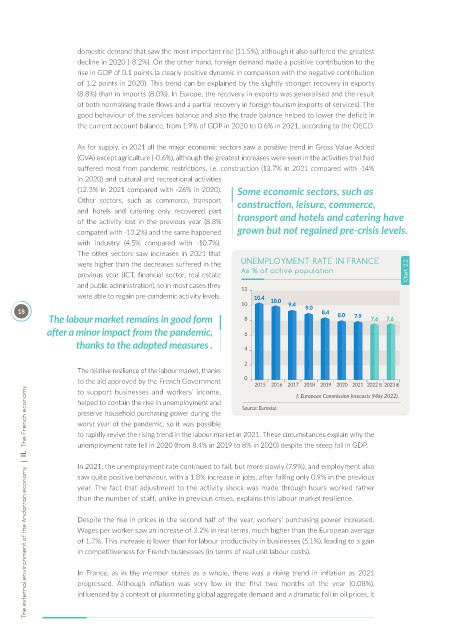
                     were higher than the decreases suffered in the   UNEMPLOYMENT RATE IN FRANCE
                     previous year (ICT, financial sector, real estate   As % of active population          Chart  2.2
                     and public administration), so in most cases they
                     were able to regain pre-pandemic activity levels.

      18
              The labour market remains in good form
             af er a minor impact from the pandemic,
                     thanks to the adopted measures .


                     The relative resilience of the labour market, thanks
                     to the aid approved by the French Government
        The external environment of the Andorran economy  |  II.  The French economy
                     to  support  businesses  and  workers’  income,
                                                                               f: European Commission forecasts (May 2022).
                     helped to contain the rise in unemployment and
                                                                 Source: Eurostat.
                     preserve household purchasing power during the
                     worst year of the pandemic, so it was possible
                     to rapidly revive the rising trend in the labour market in 2021. These circumstances explain why the
                     unemployment rate fell in 2020 (from 8.4% in 2019 to 8% in 2020) despite the steep fall in GDP.


                     In 2021, the unemployment rate continued to fall, but more slowly (7.9%), and employment also
                     saw quite positive behaviour, with a 1.8% increase in jobs, after falling only 0.9% in the previous
                     year. The fact that adjustment to the activity shock was made through hours worked rather
                     than the number of staff, unlike in previous crises, explains this labour market resilience.


                     Despite the rise in prices in the second half of the year, workers’ purchasing power increased.
                     Wages per worker saw an increase of 3.2% in real terms, much higher than the European average
                     of 1.7%. This increase is lower than for labour productivity in businesses (5.1%), leading to a gain
                     in competitiveness for French businesses (in terms of real unit labour costs).

                     In  France,  as  in  the  member  states  as  a  whole,  there  was  a  rising  trend  in  inflation  as  2021
                     progressed.  Although  inflation  was  very  low  in  the  first  two  months  of  the  year  (0.08%),
                     influenced by a context of plummeting global aggregate demand and a dramatic fall in oil prices, it

