


Page 19 - economic report 2021
P. 19
II.   The French economy


                  1.  The main features of economic development in 2021


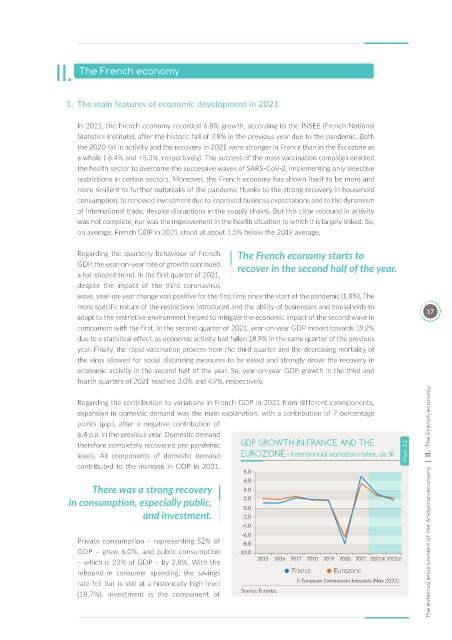
                     In 2021, the French economy recorded 6.8% growth, according to the INSEE (French National
                     Statistics Institute), after the historic fall of 7.8% in the previous year due to the pandemic. Both
                     the 2020 fall in activity and the recovery in 2021 were stronger in France than in the Eurozone as
                     a whole (-6.4% and +5.3%, respectively). The success of the mass vaccination campaign enabled
                     the health sector to overcome the successive waves of SARS-CoV-2, implementing only selective
                     restrictions in certain sectors. Moreover, the French economy has shown itself to be more and
                     more resilient to further outbreaks of the pandemic thanks to the strong recovery in household
                     consumption, to renewed investment due to improved business expectations and to the dynamism
                     of international trade, despite disruptions in the supply chains. But this clear rebound in activity
                     was not complete, nor was the improvement in the health situation to which it is largely linked. So,
                     on average, French GDP in 2021 stood at about 1.5% below the 2019 average.


                     Regarding the quarterly behaviour of French   The French economy starts to
                     GDP, the year-on-year rate of growth continued   recover in the second half of the year.
                     a hat-shaped trend. In the first quarter of 2021,
                     despite  the  impact  of  the  third  coronavirus
                     wave, year-on-year change was positive for the first time since the start of the pandemic (1.8%). The
                     more specific nature of the restrictions introduced and the ability of businesses and households to   17
                     adapt to the restrictive environment helped to mitigate the economic impact of the second wave in
                     comparison with the first. In the second quarter of 2021, year-on-year GDP moved towards 19.2%
                     due to a statistical effect, as economic activity had fallen 18.9% in the same quarter of the previous
                     year. Finally, the rapid vaccination process from the third quarter and the decreasing mortality of
                     the virus allowed for social distancing measures to be eased and strongly drove the recovery in
                     economic activity in the second half of the year. So, year-on-year GDP growth in the third and
                     fourth quarters of 2021 reached 3.0% and 4.9%, respectively.

                     Regarding the contribution to variations in French GDP in 2021 from different c≤omponents,
                     expansion in domestic demand was the main explanation, with a contribution of 7 percentage
                     points  (p.p.),  after  a  negative  contribution  of
                     6.4 p.p. in the previous year. Domestic demand
                     therefore completely recovered pre-pandemic   GDP GROWTH IN FRANCE AND THE
                     levels.  All  components  of  domestic  demand   EUROZONE - Interannual variation rates, as %  Chart  2.1
                     contributed  to  the  increase  in  GDP  in  2021.

                         There was a strong recovery

                   in consumpt on, especially public,                                                             The external environment of the Andorran economy  |  II.  The French economy
                                       and investment.


                     Private consumption – representing 52% of
                     GDP – grew 6.0%, and public consumption
                     – which is 23% of GDP – by 2.8%. With the
                     rebound  in  consumer  spending,  the  savings           France     Eurozone
                     rate fell but is still at a historically high level       f: European Commission forecasts (May 2022).
                                                                 Source: Eurostat.
                     (18.7%).  Investment  is  the  component  of

