


Page 25 - economic report 2021
P. 25
In 2021, domest c demand made a             positive, it has to be considered alongside the
                  more posit ve contribut on to GDP           fact that foreign tourism is still far from pre-
                      recovery than foreign demand.           pandemic figures (Spain received 83.5 million
                                                              foreign  tourists  in  2019).  Finally,  the  Spanish
                                                              economy ended the year with a surplus in the
                     current account balance of 0.9%, a figure that continues a positive trend in comparison with 2020,
                     when the surplus was 0.8% of GDP.


                     Within  domestic  demand,  private  consumption  was  behind  the  economic  recovery  in  2021,
                     especially in the second half of the year, thanks to easing of the restrictive measures on economic
                     activity and also the high level of savings amassed during the pandemic. Nevertheless, household
                     consumption  in  2021  was  still  about  6.3%
                     lower than in 2019. Although in year-on-year   In 2021, private consumpt on and
                     terms,  growth  in  private  consumption  was   investment grew strongly, but did not
                     lower than in GDP (4.7% compared with 5.1%),
                     the  significance  of  this  component  (which   regain pre-pandemic levels.
                     represented 55% of GDP in 2021) meant that
                     its contribution to GDP growth was 2.6 percentage points (practically half of the growth in the
                     Spanish economy in that year). In contrast, growth in public administration consumption was two
                     tenths lower than the figure in 2020, being 3.1%. It is important to note that, from the start of the
                     pandemic, public consumption grew due to increased procurement in the public sector (health,
                     education and public administration) and the aid to the most affected groups.


                                                              Investment  also  saw  a  very  positive  trend  in
               UNEMPLOYMENT RATE IN SPAIN                     2021, with growth of 6.8%, a clearly higher rate
               As % of active population                  Chart  3.2   to that of overall GDP. This dynamic is a clear sign   23
                                                              of  economic  recovery,  as  investment  reflects
                                                              increasing confidence in economic development
                                                              and in future business profits, although it also
                                                              benefited from the ECB’s expansive monetary
                                                              policy. Moreover, the arrival of €9,000 million
                                                              from the Next Generation EU fund in 2021
                                                              meant an additional input of funds, although
                                                              the multiplier effect on private investment was
                                                              very small this year.


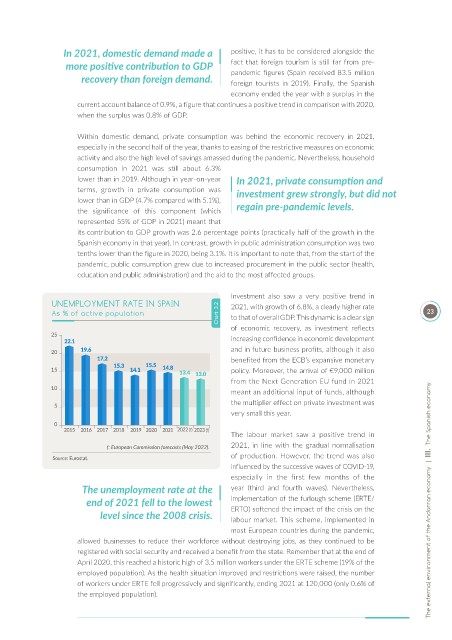
                                                              The  labour  market  saw  a  positive  trend  in
                             f: European Commission forecasts (May 2022).  2021,  in  line  with  the  gradual  normalisation
               Source: Eurostat.                              of production. However, the trend was also
                                                              influenced by the successive waves of COVID-19,
                                                              especially  in  the  first  few  months  of  the
                       The unemployment rate at the           year  (third  and  fourth  waves).  Nevertheless,

                        end of 2021 fell to the lowest        implementation of the furlough scheme (ERTE/        The external environment of the Andorran economy  |  III.  The Spanish economy
                           level since the 2008 crisis.       ERTO) softened the impact of the crisis on the
                                                              labour market. This scheme, implemented in
                                                              most European countries during the pandemic,
                     allowed businesses to reduce their workforce without destroying jobs, as they continued to be
                     registered with social security and received a benefit from the state. Remember that at the end of
                     April 2020, this reached a historic high of 3.5 million workers under the ERTE scheme (19% of the
                     employed population). As the health situation improved and restrictions were raised, the number
                     of workers under ERTE fell progressively and significantly, ending 2021 at 120,000 (only 0.6% of
                     the employed population).

