


Page 96 - economic report 2021
P. 96
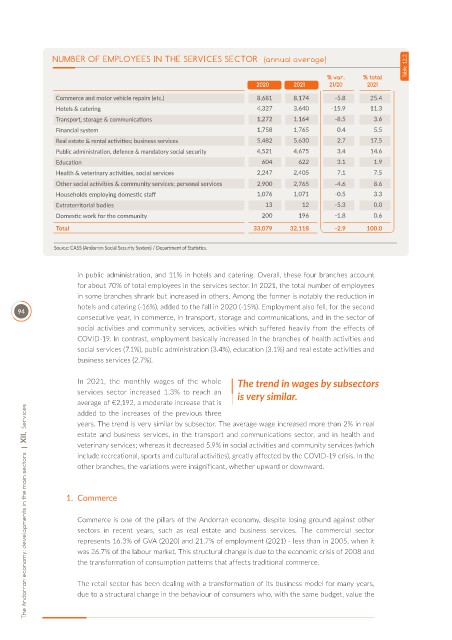
Table  12.2
               NUMBER OF EMPLOYEES IN THE SERVICES SECTOR  (annual average)
                                                                                       % var.    % total
                                                                     2020     2021      21/20     2021

                Commerce and motor vehicle repairs (etc.)            8,681    8,174      -5.8      25.4
                Hotels & catering                                    4,327    3,640     -15.9      11.3
                Transport, storage & communicat ons                  1,272    1,164      -8.5      3.6
                Financial system                                     1,758    1,765       0.4      5.5
                Real estate & rental act vit es; business services   5,482    5,630       2.7      17.5
                Public administrat on, defence & mandatory social security   4,521  4,675  3.4     14.6
                Educat on                                             604       622       3.1      1.9
                Health & veterinary act vit es, social services      2,247    2,405       7.1      7.5
                Other social act vit es & community services; personal services  2,900  2,765  -4.6  8.6
                Households employing domest c staf                   1,076    1,071      -0.5      3.3
                Extraterritorial bodies                                13        12      -5.3      0.0
                Domest c work for the community                       200       196      -1.8      0.6
                Total                                               33,079   32,118      -2.9     100.0

               Source: CASS (Andorran Social Security System) / Department of Stat st cs.


                     in public administration, and 11% in hotels and catering. Overall, these four branches account
                     for about 70% of total employees in the services sector. In 2021, the total number of employees
                     in some branches shrank but increased in others. Among the former is notably the reduction in
                     hotels and catering (-16%), added to the fall in 2020 (-15%). Employment also fell, for the second
      94
                     consecutive year, in commerce, in transport, storage and communications, and in the sector of
                     social activities and community services, activities which suffered heavily from the effects of
                     COVID-19. In contrast, employment basically increased in the branches of health activities and
                     social services (7.1%), public administration (3.4%), education (3.1%) and real estate activities and
                     business services (2.7%).


                     In  2021,  the  monthly  wages  of  the  whole   The trend in wages by subsectors
                     services  sector  increased  1.3%  to  reach  an   is very similar.
                     average of €2,192, a moderate increase that is
        The Andorran economy: developments in the main sectors  |  XII.  Services
                     added to the increases of the previous three
                     years. The trend is very similar by subsector. The average wage increased more than 2% in real
                     estate  and  business  services,  in  the  transport  and  communications  sector,  and  in  health  and
                     veterinary services; whereas it decreased 5.9% in social activities and community services (which
                     include recreational, sports and cultural activities), greatly affected by the COVID-19 crisis. In the
                     other branches, the variations were insignificant, whether upward or downward.


                  1.   Commerce


                     Commerce is one of the pillars of the Andorran economy, despite losing ground against other
                     sectors  in  recent  years,  such  as  real  estate  and  business  services.  The  commercial  sector
                     represents 16.3% of GVA (2020) and 21.7% of employment (2021) - less than in 2005, when it
                     was 26.7% of the labour market. This structural change is due to the economic crisis of 2008 and
                     the transformation of consumption patterns that affects traditional commerce.

                     The retail sector has been dealing with a transformation of its business model for many years,
                     due to a structural change in the behaviour of consumers who, with the same budget, value the

