


Page 52 - economic report 2021
P. 52
2019, reached €965 per month from September 2021, but with 14 yearly payments for a 40-
                     hour working week (the equivalent of 12 monthly payments of €1,126). For this reason, Andorra
                     is seeing heavy competition when recruiting workers from its neighbouring country.


                                 Construct on and the         The wage trend by sector was diverse in 2021.
                    manufacturing industries are the          On  the  one  hand,  there  were  notable  wage
                     sectors that most raised wages.          rises  in  construction  (5.1%),  manufacturing
                                                              industries  (5.1%),  extraterritorial  bodies  (3%),
                                                              real  estate  activities  and  business  services
                     (2.9%), health and veterinary activities (2.1%) and transport, storage and communications (2.6%).


                     At  the  other  extreme,  wage  decreases  were  seen  in  Other  social  activities  and  community
                     services (-5.9%), hotels and catering (-0.9%), commerce (-0.8%) and education (-0.2%). In the other
                     activities, the wage trend was positive but lower than average. In this group, there was a notable
                     slowdown in wage growth in Public administration (0.1%).


                     Consequently,  in  2020,  the  difference  between  sectors  remained  virtually  the  same.  So,  the
                     highest wage is 3.4 times higher than the lowest wage (as in 2019 and 2020). Specifically, the
                     highest remunerations are still historically found in the financial sector, where wages are 2.2 times
                     higher than the average. This level contrasts with that of domestic work for the community which
                     – with wages 37% below the average – is the worst paid sector. The second sector in the wage
                     ranks is production and distribution of electricity, gas and water, with wages 55% higher than
                     the average, followed by extraterritorial bodies – with wages 26% higher than the average - and
                     public administration – paying 21% more. Note the trend in construction in 2021, in which wages
                     went to 1% over the average after 11 years of being below, coming close to their relative level
      50
                     before the financial crisis. Among the sectors with below-average wages are notably commerce
                     and hotels and catering, two sectors that employ a large part of Andorra’s population (31.3% of
                     total employees), in which the relative position worsened, with wages 15% and 29% lower than
                     the average, respectively.

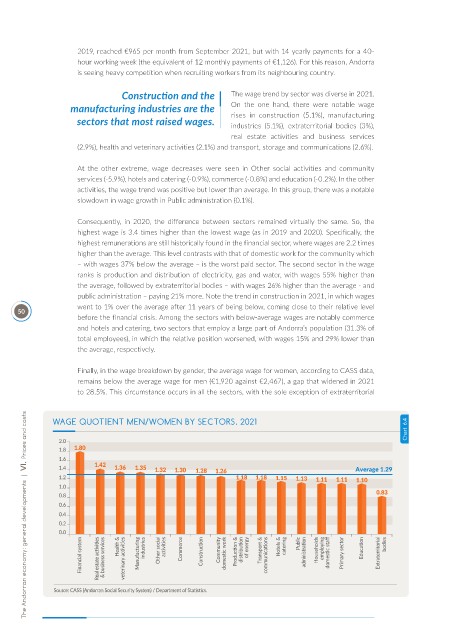
                     Finally, in the wage breakdown by gender, the average wage for women, according to CASS data,
                     remains below the average wage for men (€1,920 against €2,467), a gap that widened in 2021
                     to 28.5%. This circumstance occurs in all the sectors, with the sole exception of extraterritorial


        The Andorran economy: general developments  |  VI.  Prices and costs
               WAGE QUOTIENT MEN/WOMEN BY SECTORS. 2021
                                                                                                            Chart  6.4


               Source: CASS (Andorran Social Security System) / Department of Stat st cs.

