


Page 50 - economic report 2021
P. 50
was favoured by the existence of long-term   CONSUMER PRICE INDEX. DECEMBER 2021
                     contracts  with  foreign  energy  suppliers,  which   (base year 2018) Interannual variation rate (%)  Chart  6.2
                     mitigated the impact from the energy shock that
                     is affecting the whole of Europe.

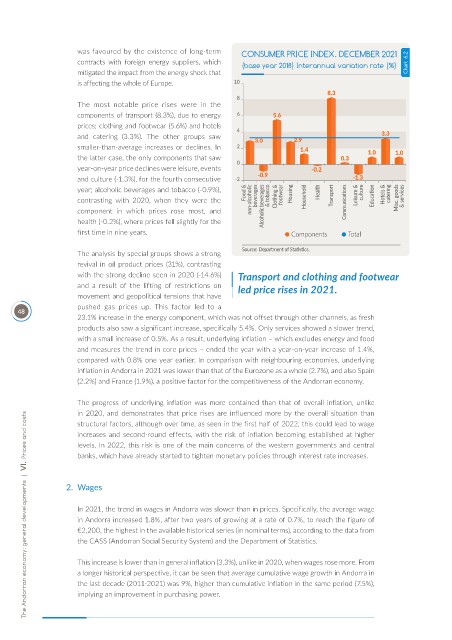
                     The  most  notable  price  rises  were  in  the
                     components of transport (8.3%), due to energy
                     prices; clothing and footwear (5.6%) and hotels
                     and  catering  (3.3%).  The  other  groups  saw
                     smaller-than-average increases or declines. In
                     the latter case, the only components that saw
                     year-on-year price declines were leisure, events
                     and culture (-1.3%), for the fourth consecutive
                     year; alcoholic beverages and tobacco (-0.9%),
                     contrasting  with  2020,  when  they  were  the
                     component  in  which  prices  rose  most,  and
                     health (-0.2%), where prices fell slightly for the
                     first time in nine years.                                Components     Total

                                                                 Source: Department of Stat st cs.
                     The analysis by special groups shows a strong
                     revival  in  oil  product  prices  (31%),  contrasting
                     with the strong decline seen in 2020 (-14.6%)   Transport and clothing and footwear
                     and  a  result  of  the  lifting  of  restrictions  on   led price rises in 2021.
                     movement and geopolitical tensions that have
                     pushed  gas  prices  up.  This  factor  led  to  a
      48
                     23.1% increase in the energy component, which was not offset through other channels, as fresh
                     products also saw a significant increase, specifically 5.4%. Only services showed a slower trend,
                     with a small increase of 0.5%. As a result, underlying inflation – which excludes energy and food
                     and measures the trend in core prices – ended the year with a year-on-year increase of 1.4%,
                     compared with 0.8% one year earlier. In comparison with neighbouring economies, underlying
                     inflation in Andorra in 2021 was lower than that of the Eurozone as a whole (2.7%), and also Spain
                     (2.2%) and France (1.9%), a positive factor for the competitiveness of the Andorran economy.

                     The  progress  of  underlying  inflation  was  more  contained  than  that  of  overall  inflation,  unlike
                     in  2020,  and  demonstrates  that  price  rises  are  influenced  more  by  the  overall  situation  than
        The Andorran economy: general developments  |  VI.  Prices and costs
                     structural factors, although over time, as seen in the first half of 2022, this could lead to wage
                     increases and second-round effects, with the risk of inflation becoming established at higher
                     levels. In 2022, this risk is one of the main concerns of the western governments and central
                     banks, which have already started to tighten monetary policies through interest rate increases.


                  2. Wages


                     In 2021, the trend in wages in Andorra was slower than in prices. Specifically, the average wage
                     in Andorra increased 1.8%, after two years of growing at a rate of 0.7%, to reach the figure of
                     €2,200, the highest in the available historical series (in nominal terms), according to the data from
                     the CASS (Andorran Social Security System) and the Department of Statistics.


                     This increase is lower than in general inflation (3.3%), unlike in 2020, when wages rose more. From
                     a longer historical perspective, it can be seen that average cumulative wage growth in Andorra in
                     the last decade (2011-2021) was 9%, higher than cumulative inflation in the same period (7.5%),
                     implying an improvement in purchasing power.

