


Page 55 - economic report 2021
P. 55
or the creation of activities linked to coupling and the creation of an added value in Andorra that
                     takes advantage of a market niche.

                     Both  exchange  rate  trends  and  changes  in  international  trade  regulations  are  major  factors
                     influencing the re-exportation of products. In 2021, the euro depreciated 7%, favouring Andorran
                     exports outside the Eurozone but at the same time creating less favourable conditions for importing
                     products from countries outside the monetary union for subsequent re-exportation to the Eurozone.


                     As for regulation, Andorra is in the process of negotiating an association agreement with the
                     EU. These negotiations, which started in 2015, were delayed by the effects of Brexit and the
                     pandemic, but the Government has already announced that the referendum on the association
                     agreement will be at the end of 2023 or beginning of 2024. Among other aspects, this agreement
                     would allow for the free circulation of goods in chapters 1 - 23 of the harmonised system while
                     continuing to exclude tobacco from the customs union for a transition period of 30 years, to allow
                     for conversion of the sector. This could open up new opportunities for trade between Andorra
                     and the EU, especially since the EU has been putting legislative obstacles in place in recent years
                     that limit the opportunities for re-exportation from Andorra.

             The reduced f nancing capacity in 2020           For the second consecutive year, the Balance of
              can be explained by declining tourism.          Payments and International Investment Position
                                                              of  the  Andorran  economy  is  available,  which
                                                              quantifies the economic relationship between
                     the residents of this economy and the residents of the rest of the world, according to the principles
                     set  out  in  the  International  Monetary  Fund’s  (IMF)  sixth  Balance  of  Payments  and  International
                     Investment Position Manual (BPM6). The 2020 balance of payments (latest available) shows that   53
                     the Andorran economy has a financing capacity (current account + capital account) of €393.23
                     million, lower than the €507.86 million of the previous year. Of the total current account, the entry
                     of goods and services shows a positive balance of €100.3 million; primary income (from work and
                     investments), a positive balance of €330.6 million, and secondary income a negative balance of
                     -€37.9 million. The importance of the goods and services account clearly demonstrates that the
                     Principality of Andorra is an exporter of services (with a balance of €1,022 million) and importer of
                     goods (with a balance of -€922 million). The reduction in financing capacity in 2020 can basically
                     be explained by the reduction in the positive balance of services due to the drop in foreign tourism
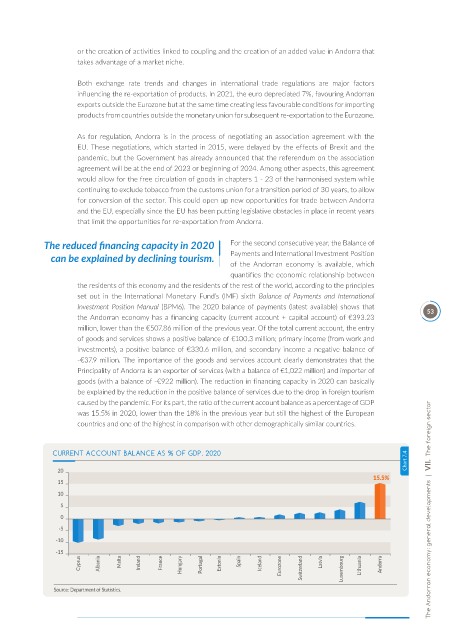
                     caused by the pandemic. For its part, the ratio of the current account balance as a percentage of GDP
                     was 15.5% in 2020, lower than the 18% in the previous year but still the highest of the European
                     countries and one of the highest in comparison with other demographically similar countries.


                                                                                                            Chart 7.4   The Andorran economy: general developments  |  VII.  The foreign sector
               CURRENT ACCOUNT BALANCE AS % OF GDP. 2020


               Source: Department of Stat st cs.

