


Page 49 - economic report 2021
P. 49
For its part, the IMF is more cautious and predicts 4.5% economic growth in Andorra in 2022,
                     which would enable it to recover the pre-crisis level during the second half of 2022. Equally,
                     the institution states that the downward risks in these forecasts are significant and are related
                     to the economic impact on Europe of the war in Ukraine, the marked rise in commodity prices,
                     an unfavourable trend in the pandemic, weaker recoveries than expected in the neighbouring
                     economies and more restrictive financial conditions. The IMF highlights as positive factors to
                     tackle these risks, the fiscal margin still held by the government, the current account surplus, the
                     accumulated foreign reserves and a banking system with good levels of liquidity and capitalisation.

                     In the mid-term, the IMF predicts that growth will converge towards its potential of 1.5%, while in
                     relation to prices, it considers that inflationary pressures will persist in 2022 and early 2023 due to
                     high energy prices, as in the neighbouring economies, and that the pressures will then gradually ease.


              VI.      Prices and costs


                  1.  Consumer prices

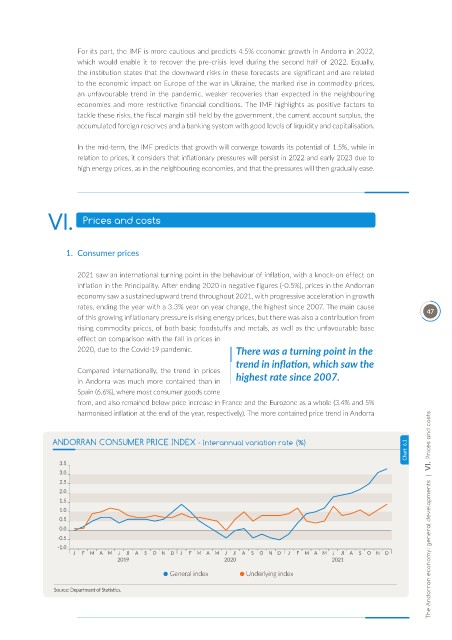
                     2021 saw an international turning point in the behaviour of inflation, with a knock-on effect on
                     inflation in the Principality. After ending 2020 in negative figures (-0.5%), prices in the Andorran
                     economy saw a sustained upward trend throughout 2021, with progressive acceleration in growth
                     rates, ending the year with a 3.3% year on year change, the highest since 2007. The main cause   47
                     of this growing inflationary pressure is rising energy prices, but there was also a contribution from
                     rising commodity prices, of both basic foodstuffs and metals, as well as the unfavourable base
                     effect on comparison with the fall in prices in
                     2020, due to the Covid-19 pandemic.       There was a turning point in the
                                                               trend in inf at on, which saw the
                     Compared  internationally,  the  trend  in  prices
                     in Andorra was much more contained than in   highest rate since 2007.
                     Spain (6.6%), where most consumer goods come
                     from, and also remained below price increase in France and the Eurozone as a whole (3.4% and 5%
                     harmonised inflation at the end of the year, respectively). The more contained price trend in Andorra


                                                                                                            Chart  6.1
               ANDORRAN CONSUMER PRICE INDEX - Interannual variation rate (%)


                                              General index       Underlying index                                The Andorran economy: general developments  |  VI.  Prices and costs
               Source: Department of Stat st cs.

