


Page 41 - economic report 2021
P. 41
Box 5.1
                  INCOME DISTRIBUTION, LIVING CONDITIONS AND RISK OF POVERTY IN ANDORRA


                 In  2020  (income  data  for  2019),  the  Andorran   with the working age. People aged 65 and above have
                 population  had  an  average  income  per  consumption   a  slightly  lower  average  income  (€28,653)  and  the
                 unit  of  €28,502.  By  gender,  the  average  of  men   lowest level is that of under-16s (€24,412 on average).
                 (€30,360)  was  14.3%  higher  than  that  of  women
                 (€26,573).                                    As for the housing regime, the income of those who
                                                               live in rented housing (€25,545) is, on average, 23.7%
                 Income distribution also presents differences by age   lower  than  those  who  own  their  main  residence
                 groups. The highest figure is that of the population   (€33,499).
                 between the ages of 16-64 (€29,366), which coincides
                                                               Regarding income distribution, in 2020, 20% of the
                                                               population  with  lower  incomes  had  9.1%  of  total
                   AT-RISK-OF-POVERTY RATE IN ANDORRA          income, whereas 20% of the population with higher
                   COMPARED WITH EUROPE
                   As % of population                          income had 38.0% of the income.

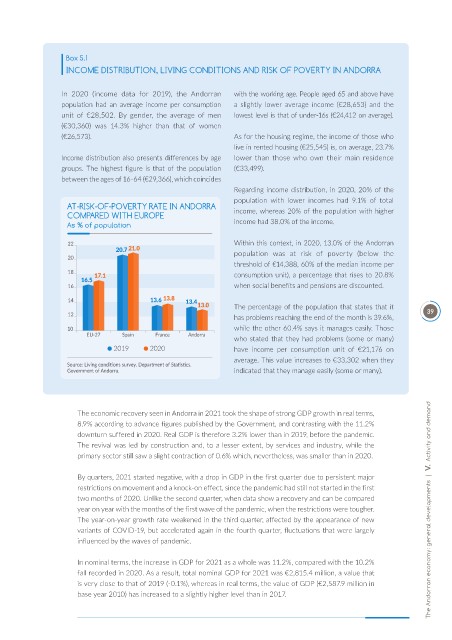
                                                               Within this context, in 2020, 13.0% of the Andorran
                                                               population  was  at  risk  of  poverty  (below  the
                                                               threshold of €14,388, 60% of the median income per
                                                               consumption unit), a percentage that rises to 20.8%
                                                               when social benefits and pensions are discounted.


                                                               The percentage of the population that states that it   39
                                                               has problems reaching the end of the month is 39.6%,
                                                               while the other 60.4% says it manages easily. Those
                                                               who stated that they had problems (some or many)
                               2019      2020                  have  income  per  consumption  unit  of  €21,176  on
                                                               average. This value increases to €33,302 when they
                   Source: Living condit ons survey. Department of Stat st cs.
                   Government of Andorra.                      indicated that they manage easily (some or many).


                     The economic recovery seen in Andorra in 2021 took the shape of strong GDP growth in real terms,
                     8.9% according to advance figures published by the Government, and contrasting with the 11.2%
                     downturn suffered in 2020. Real GDP is therefore 3.2% lower than in 2019, before the pandemic.
                     The revival was led by construction and, to a lesser extent, by services and industry, while the
                     primary sector still saw a slight contraction of 0.6% which, nevertheless, was smaller than in 2020.


                     By quarters, 2021 started negative, with a drop in GDP in the first quarter due to persistent major
                     restrictions on movement and a knock-on effect, since the pandemic had still not started in the first
                     two months of 2020. Unlike the second quarter, when data show a recovery and can be compared
                     year on year with the months of the first wave of the pandemic, when the restrictions were tougher.   The Andorran economy: general developments  |  V.  Activity and demand
                     The year-on-year growth rate weakened in the third quarter, affected by the appearance of new
                     variants of COVID-19, but accelerated again in the fourth quarter, fluctuations that were largely
                     influenced by the waves of pandemic.


                     In nominal terms, the increase in GDP for 2021 as a whole was 11.2%, compared with the 10.2%
                     fall recorded in 2020. As a result, total nominal GDP for 2021 was €2,815.4 million, a value that
                     is very close to that of 2019 (-0.1%), whereas in real terms, the value of GDP (€2,587.9 million in
                     base year 2010) has increased to a slightly higher level than in 2017.

