


Page 33 - economic report 2021
P. 33
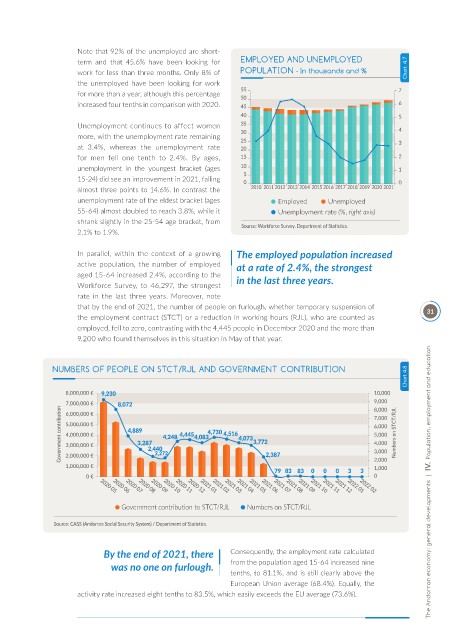
Note that 92% of the unemployed are short-
                     term  and  that  45.6%  have  been  looking  for   EMPLOYED AND UNEMPLOYED
                     work for less than three months. Only 8% of   POPULATION - In thousands and %          Chart  4.7
                     the  unemployed  have  been  looking  for  work
                     for more than a year, although this percentage
                     increased four tenths in comparison with 2020.


                     Unemployment continues to affect women
                     more, with the unemployment rate remaining
                     at  3.4%,  whereas  the  unemployment  rate
                     for  men  fell  one  tenth  to  2.4%.  By  ages,
                     unemployment  in  the  youngest  bracket  (ages
                     15-24) did see an improvement in 2021, falling
                     almost three points to 14.6%. In contrast the
                     unemployment rate of the eldest bracket (ages        Employed     Unemployed
                     55-64) almost doubled to reach 3.8%, while it        Unemployment rate (%, right axis)
                     shrank slightly in the 25-54 age bracket, from   Source: Workforce Survey. Department of Stat st cs.
                     2.1% to 1.9%.


                     In  parallel,  within  the  context  of  a  growing   The employed populat on increased
                     active  population,  the  number  of  employed   at a rate of 2.4%, the strongest
                     aged 15-64 increased 2.4%, according to the   in the last three years.
                     Workforce  Survey,  to  46,297,  the  strongest
                     rate  in  the  last  three  years.  Moreover,  note
                     that by the end of 2021, the number of people on furlough, whether temporary suspension of   31
                     the employment contract (STCT) or a reduction in working hours (RJL), who are counted as
                     employed, fell to zero, contrasting with the 4,445 people in December 2020 and the more than
                     9,200 who found themselves in this situation in May of that year.


               NUMBERS OF PEOPLE ON STCT/RJL AND GOVERNMENT CONTRIBUTION
                                                                                                            Chart 4.8


                                 Government contribut on to STCT/RJL   Numbers on STCT/RJL                        The Andorran economy: general developments  |  IV.  Population, employment and education

               Source: CASS (Andorran Social Security System) / Department of Stat st cs.


                            By the end of 2021, there         Consequently, the employment rate calculated
                              was no one on furlough.         from the population aged 15-64 increased nine
                                                              tenths, to 81.1%, and is still clearly above the
                                                              European Union average (68.4%). Equally, the
                     activity rate increased eight tenths to 83.5%, which easily exceeds the EU average (73.6%).

