


Page 70 - economic report 2021
P. 70
To complete the analysis of revenue, we must add that in 2021, €6.8 million were obtained in
                     revenue from current transfers, mainly relating to the contributions from the Comú governments
                     to the central Government’s solidarity fund to tackle the pandemic. In the case of real investments
                     and capital transfers, the contributions obtained were insignificant.


                 1.2.   Expenditure


                     In 2021, settled non-financial expenditure saw an adjustment that reached €492.1 million, 2.2%
                     less than in the previous year, after a two-digit increase in 2020 (14.7%). This containment affected
                     both current expenditure and capital expenditure. The reduction in non-financial expenditure
                     contrasted with the strong growth in revenue, the opposite of the previous year and the result of
                     the improving health situation and consequent progressive reduction in the temporary measures
                     that the central government had adopted to offset the effects of the pandemic on income.


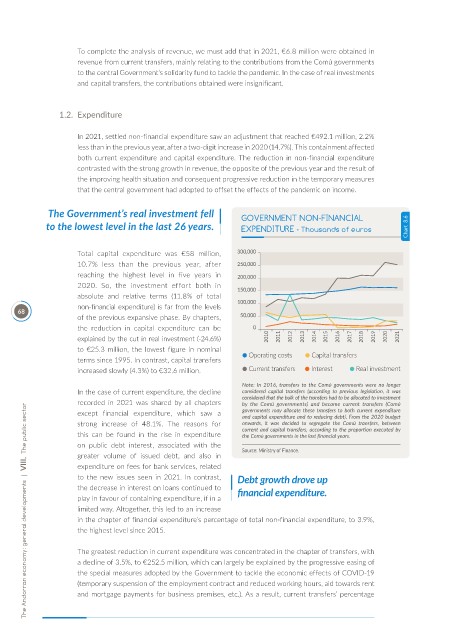
              The Government’s real investment fell              GOVERNMENT NON-FINANCIAL
             to the lowest level in the last 26 years.           EXPENDITURE - Thousands of euros           Chart  8.6


                     Total  capital  expenditure  was  €58  million,
                     10.7%  less  than  the  previous  year,  after
                     reaching  the  highest  level  in  five  years  in
                     2020.  So,  the  investment  effort  both  in
                     absolute  and  relative  terms  (11.8%  of  total
                     non-financial expenditure) is far from the levels
      68
                     of the previous expansive phase. By chapters,
                     the  reduction  in  capital  expenditure  can  be
                     explained by the cut in real investment (-24.6%)
                     to  €25.3  million,  the  lowest  figure  in  nominal   Operat ng costs  Capital transfers
                     terms since 1995. In contrast, capital transfers
                     increased slowly (4.3%) to €32.6 million.     Current transfers  Interest  Real investment

                                                                 Note:  In  2016,  transfers  to  the  Comú  governments  were  no  longer
                     In the case of current expenditure, the decline   considered  capital  transfers  (according  to  previous  legislation,  it  was
                     recorded  in  2021  was  shared  by  all  chapters   considered that the bulk of the transfers had to be allocated to investment
                                                                 by  the  Comú  governments)  and  became  current  transfers  (Comú
        The Andorran economy: general developments  |  VIII.  The public sector
                     except  financial  expenditure,  which  saw  a   governments  may  allocate  these  transfers  to  both  current  expenditure
                                                                 and capital expenditure and to reducing debt). From the 2020 budget
                     strong  increase  of  48.1%.  The  reasons  for   onwards,  it  was  decided  to  segregate  the  Comú  transfers,  between
                     this  can  be  found  in  the  rise  in  expenditure   current and capital transfers, according to the proportion executed by
                                                                 the Comú governments in the last financial years.
                     on  public  debt  interest,  associated  with  the
                     greater  volume  of  issued  debt,  and  also  in   Source: Ministry of Finance.
                     expenditure on fees for bank services, related
                     to  the  new  issues  seen  in  2021.  In  contrast,   Debt growth drove up
                     the decrease in interest on loans continued to   f nancial expenditure.
                     play in favour of containing expenditure, if in a
                     limited way. Altogether, this led to an increase
                     in the chapter of financial expenditure’s percentage of total non-financial expenditure, to 3.9%,
                     the highest level since 2015.


                     The greatest reduction in current expenditure was concentrated in the chapter of transfers, with
                     a decline of 3.5%, to €252.5 million, which can largely be explained by the progressive easing of
                     the special measures adopted by the Government to tackle the economic effects of COVID-19
                     (temporary suspension of the employment contract and reduced working hours, aid towards rent
                     and mortgage payments for business premises, etc.). As a result, current transfers’ percentage

