


Page 66 - economic report 2021
P. 66
In 2021, social contributions were still the most important component of the tax burden, at
                     39.9%, although this was lower than the 42.8% they represented in 2020. Indirect taxation is the
                     second component, with a 36.8%, contribution to the total, the same as in 2020. Finally, direct
                     taxation increased in importance in 2021 by 2.9 percentage points, to represent 23.3%, thanks to
                     the increase in revenue from taxes on income, especially corporate tax (IS), personal income tax
                     (IRPF), non-resident’s income tax (IRNR) and capital gains tax on property.


                     Below is an analysis of the public sector performance in 2021, according to each level of
                     administration.


                  1.   Central Government

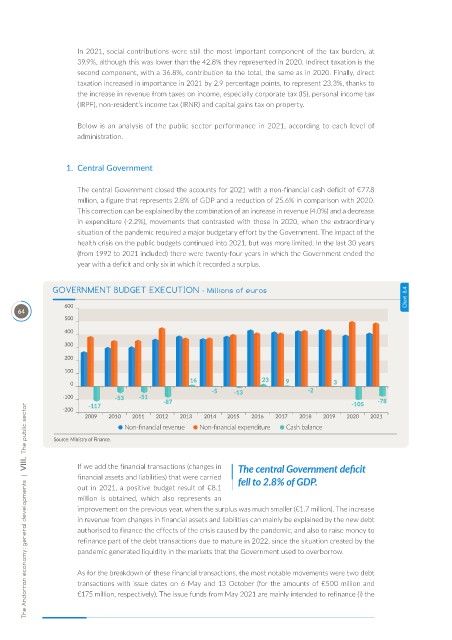
                     The central Government closed the accounts for 2021 with a non-financial cash deficit of €77.8
                     million, a figure that represents 2.8% of GDP and a reduction of 25.6% in comparison with 2020.
                     This correction can be explained by the combination of an increase in revenue (4.0%) and a decrease
                     in expenditure (-2.2%), movements that contrasted with those in 2020, when the extraordinary
                     situation of the pandemic required a major budgetary effort by the Government. The impact of the
                     health crisis on the public budgets continued into 2021, but was more limited. In the last 30 years
                     (from 1992 to 2021 included) there were twenty-four years in which the Government ended the
                     year with a deficit and only six in which it recorded a surplus.


               GOVERNMENT BUDGET EXECUTION - Millions of euros
                                                                                                            Chart  8.4

      64


        The Andorran economy: general developments  |  VIII.  The public sector


                                  Non-f nancial revenue  Non-f nancial expenditure  Cash balance
               Source: Ministry of Finance.


                     If we add the financial transactions (changes in   The central Government def cit
                     financial assets and liabilities) that were carried   fell to 2.8% of GDP.
                     out in 2021, a positive budget result of €8.1
                     million  is  obtained,  which  also  represents  an
                     improvement on the previous year, when the surplus was much smaller (€1.7 million). The increase
                     in revenue from changes in financial assets and liabilities can mainly be explained by the new debt
                     authorised to finance the effects of the crisis caused by the pandemic, and also to raise money to
                     refinance part of the debt transactions due to mature in 2022, since the situation created by the
                     pandemic generated liquidity in the markets that the Government used to overborrow.

                     As for the breakdown of these financial transactions, the most notable movements were two debt
                     transactions with issue dates on 6 May and 13 October (for the amounts of €500 million and
                     €175 million, respectively). The issue funds from May 2021 are mainly intended to refinance (i) the

