


Page 106 - economic report 2021
P. 106
3.   Tourism

                     According to the official GDP figures, in 2020 (latest available data) the hotels and catering sector
                     represented 6.3% of Andorran GVA, two points less than in 2019, due to the health crisis caused
                     by SARS-CoV-2. Despite the fact that tourism’s direct percentage of GVA is not high, its indirect
                     impact is much higher, as it strongly influences other sectors, such as commerce and leisure and
                     sporting activities, which greatly depend on foreign visitors.


                     The tourism sector, having played a major role   Despite the increase in numbers of
                     in  Andorran  economic  growth  over  recent   visitors in 2021, the f gure is st ll 34%
                     years, faced an especially complicated situation
                     in 2020 and 2021 due to the health crisis. In   smaller than in 2019.
                     2020, the number of visitors plummeted 37%
                     and only recovered 4.1% in 2021, to 5.4 million, so the number of visitors is still 34% lower
                     than in 2019 (when it was 8.2 million). As international restrictions on movement were lifted in
                     2021, activity revived to some extent over the summer and winter months, thanks to the good
                     performance of proximity tourism, although sectoral expectations were not generally met and
                     it was far from recovering pre-pandemic levels of activity due to the various waves of the virus.


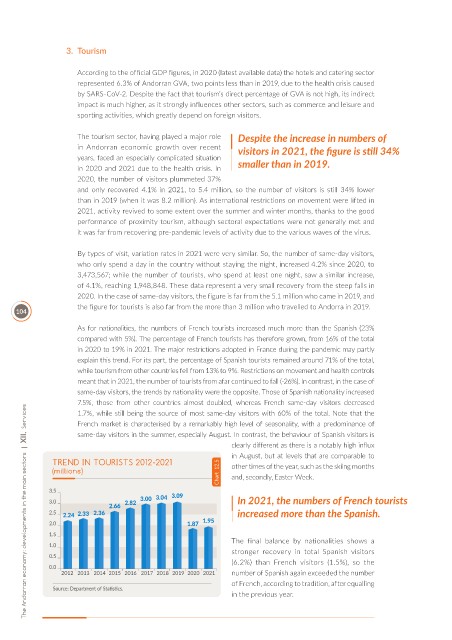
                     By types of visit, variation rates in 2021 were very similar. So, the number of same-day visitors,
                     who only spend a day in the country without staying the night, increased 4.2% since 2020, to
                     3,473,567; while the number of tourists, who spend at least one night, saw a similar increase,
                     of 4.1%, reaching 1,948,848. These data represent a very small recovery from the steep falls in
                     2020. In the case of same-day visitors, the figure is far from the 5.1 million who came in 2019, and
                     the figure for tourists is also far from the more than 3 million who travelled to Andorra in 2019.
     104
                     As for nationalities, the numbers of French tourists increased much more than the Spanish (23%
                     compared with 5%). The percentage of French tourists has therefore grown, from 16% of the total
                     in 2020 to 19% in 2021. The major restrictions adopted in France during the pandemic may partly
                     explain this trend. For its part, the percentage of Spanish tourists remained around 71% of the total,
                     while tourism from other countries fell from 13% to 9%. Restrictions on movement and health controls
                     meant that in 2021, the number of tourists from afar continued to fall (-26%). In contrast, in the case of
                     same-day visitors, the trends by nationality were the opposite. Those of Spanish nationality increased
                     7.5%,  those  from  other  countries  almost  doubled,  whereas  French  same-day  visitors  decreased
        The Andorran economy: developments in the main sectors  |  XII.  Services
                     1.7%, while still being the source of most same-day visitors with 60% of the total. Note that the
                     French market is characterised by a remarkably high level of seasonality, with a predominance of
                     same-day visitors in the summer, especially August. In contrast, the behaviour of Spanish visitors is
                                                              clearly different as there is a notably high influx
                                                              in August, but at levels that are comparable to
               TREND IN TOURISTS 2012-2021                    other times of the year, such as the skiing months
              (millions)                                   Chart  12.5   and, secondly, Easter Week.


                                                                In 2021, the numbers of French tourists
                                                                increased more than the Spanish.


                                                              The  final  balance  by  nationalities  shows  a
                                                              stronger  recovery  in  total  Spanish  visitors
                                                              (6.2%)  than  French  visitors  (1.5%),  so  the
                                                              number of Spanish again exceeded the number
                                                              of French, according to tradition, after equalling
               Source: Department of Stat st cs.
                                                              in the previous year.

